
Santol Edge Team
AI Research & Engineering at Santol Edge
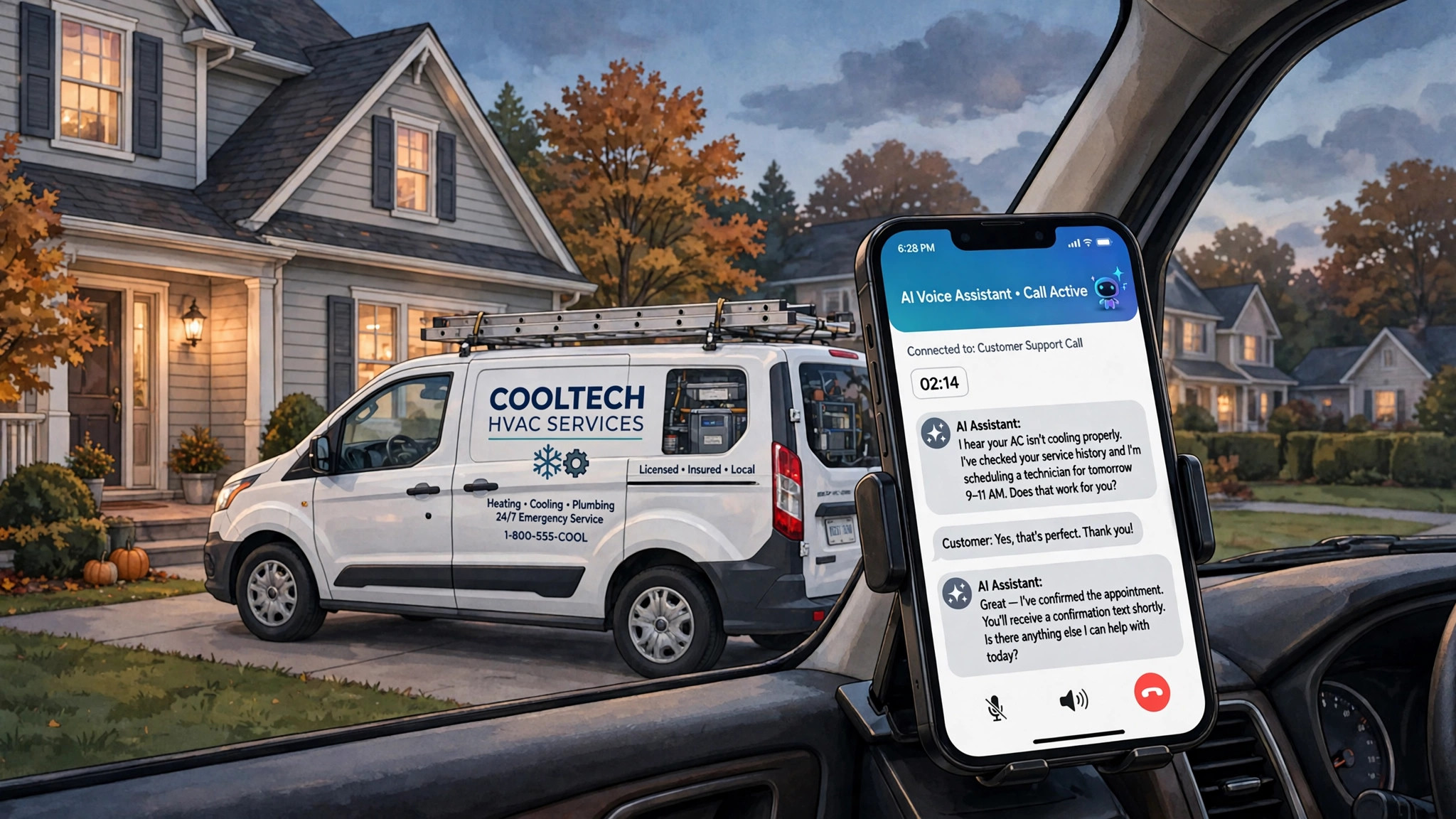

“AI Voice Agents for Home Services: Never Miss an Emergency Call Again (2026)”
# AI Voice Agents for Home Services: Never Miss an Emergency Call Again
A homeowner's pipe bursts at 11 PM. They call three plumbers. The first two go to voicemail; the third picks up — or rather, an AI voice agent picks up, takes the details, and books the emergency visit. Guess who gets the job.
Home services run on the phone. Plumbing, HVAC, electrical, roofing, pest control — the highest-value jobs arrive as calls, often after hours, often urgent, and almost always to a team that is on a job site with their hands full. Every missed call is a job that goes to whoever answered. AI voice agents exist for exactly this: every call answered, every job qualified, every booking captured.
## The Missed-Call Math
For a home services business, the phone is the storefront. Consider what a missed call actually costs: not just one job, but the lifetime value of a customer who now calls your competitor first next time. Emergency work — burst pipes, dead furnaces in winter, power outages — goes to whoever responds in minutes, not whoever calls back in the morning.
The old answers all have holes. Voicemail gets ignored. An answering service takes messages but cannot qualify urgency or book the job. Hiring a full-time dispatcher is expensive and still leaves nights and weekends uncovered. An AI voice agent fills the gap: it answers on the first ring, around the clock, handles the conversation naturally, and books the work.
## What a Home Services Voice Agent Actually Does
Answers every call instantly. First ring, 24/7 — nights, weekends, holidays, and the middle of a job when nobody can pick up. The caller hears a natural, professional greeting, not a robot menu.
Qualifies the job. The agent asks the questions your dispatcher would ask: what is the problem, where are you located, is this an emergency or can it wait, is there water or safety risk right now. Emergency calls get flagged and escalated immediately; routine work gets scheduled normally.
Books into your calendar. The agent checks real availability and books the visit — emergency slots for emergencies, standard slots for the rest. The customer gets a confirmation by text; your team sees a booked job with the details attached.
Captures the details. Name, address, phone number, problem description, photos if needed — everything your technician needs to arrive prepared. No more "someone called about a leak, I think" messages.
Follows up automatically. Quotes that go cold get professional follow-up. Completed jobs trigger review requests. Maintenance reminders go out on schedule. The agent keeps working the pipeline your team is too busy to touch.
Handles the overflow, not just the after-hours. Even during business hours, when all lines are busy or the office manager is with a customer, the voice agent takes the overflow — so peak demand never becomes missed demand.
## What It Should Not Do
An AI voice agent should not diagnose complex problems over the phone beyond basic triage — its job is to qualify and book, not to replace the technician's judgment. It should not quote firm prices for work it cannot see; it can give honest ranges for standard jobs and book an on-site estimate for everything else. And it should identify itself appropriately — customers are fine talking to an automated assistant when it is helpful and honest about what it is.
Emergency escalation needs a human path: for genuine emergencies, the agent should be able to reach the on-call technician directly, not just log a ticket. Define that escalation chain before launch.
## What It Costs
An AI voice agent for a home services business is a standard voice agent build with job-qualification flows and calendar booking. Our AI Voice Agent Setup is $1,200 one-time (USD) — the agent itself, trained on your services and service area, answering your business line. Per-minute voice usage charges apply on top (estimated honestly during scoping — they depend on your call volume), and anything beyond the standard scope — multi-location routing, deep dispatch-system integration, custom emergency escalation chains — is a fixed quote after a free consultation.
Compare that honestly against the alternatives: a missed emergency job is often worth more than the entire setup. An answering service costs monthly forever and books nothing. A dispatcher costs a salary and sleeps at night.
## The Launch Checklist
1. Map your call types: emergency, urgent same-day, routine booking, quote request, existing customer.
2. Define the qualification questions for each type — what does the technician need to know before arriving.
3. Set the emergency escalation chain: who gets called, in what order, how fast.
4. Connect the agent to your real calendar and booking system — not a spreadsheet nobody checks.
5. Decide your honest price ranges for standard jobs and the "book an estimate" path for the rest.
6. Test with realistic calls: panicked homeowners, vague descriptions, bad connections.
7. Set up review requests and follow-up sequences from day one.
In home services, the business goes to whoever answers. An AI voice agent makes sure that is always you. [Contact us](/contact) for a free consultation — we will map your call flow and tell you honestly what a voice agent would capture.
Santol Edge Team
AuthorWrites extensively about generative AI, autonomous agent design, enterprise automation architectures, and customer experience engineering at Santol Edge.
Read Next

How AI Automation Helps Modern Businesses Scale 10x Faster
Discover how forward-thinking companies are deploying intelligent agents and automated pipelines to reduce overhead and boost revenue.

How AI Chatbots Transform Customer Support and Business Growth
Learn how AI chatbots improve customer response times, qualify leads, support teams, and create more consistent customer experiences.

AI Voice Agents: What They Are and How They Work
Understand where voice agents add value, how they connect with business systems, and what to consider before launching one.
Community Comments (0)
Sep 28, 2026Elisa Gabriella
VP of Operations · BrightSync
“A genuinely useful piece — the point about consolidating thin pages matches what we saw on our own platform last year. Deploying automated workflows cut roughly half our manual ticket volume and resolution speed went up significantly.”
Leave a Reply
Your email address will not be published. Required fields are marked *