
Santol Edge Team
AI Research & Engineering at Santol Edge
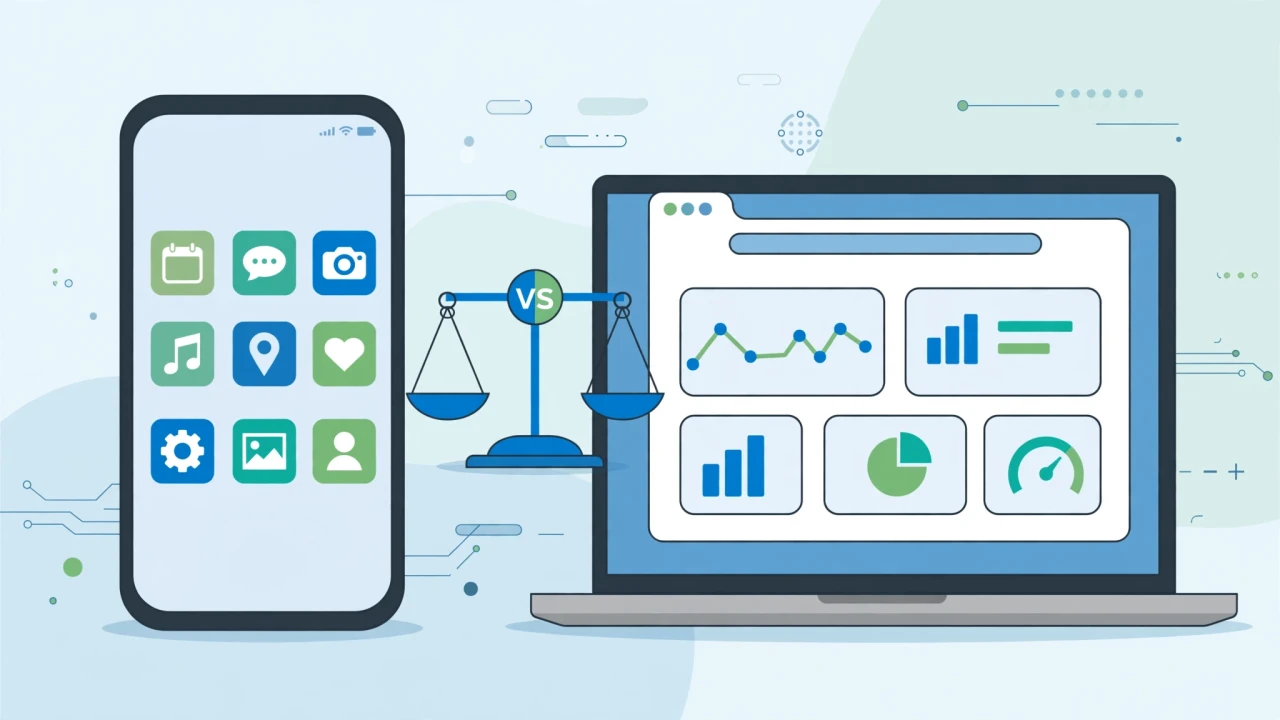

“Mobile App vs Web App: Which Should You Build in 2026?”
<h1>Mobile App vs Web App: Which Should You Build in 2026?</h1>
<p>If you have a product idea, one of the first big decisions is <strong>mobile app vs web app</strong>: do you build something people install from an app store, or something they open in a browser? Get this wrong and you can spend months — and a lot of money — building on the wrong platform.</p>
<p>The good news: in 2026, the decision is clearer than ever. It is less about technology and more about strategy — your users, your budget, and your timeline. Here is how to think it through.</p>
<h2>What Each One Actually Is</h2>
<ul>
<li><strong>Web app:</strong> an application that lives at a URL and runs in any modern browser — on desktop, tablet, or phone. Nothing to install, nothing to approve. Think dashboards, booking portals, marketplaces, and SaaS tools.</li>
<li><strong>Native mobile app:</strong> software built for iOS and/or Android that users install from an app store. It runs on the device and can use the camera, GPS, push notifications, and offline storage. This is what most people picture when they say "an app."</li>
<li><strong>PWA (Progressive Web App):</strong> a web app upgraded so it can be installed to the home screen, work partly offline, and send push notifications. A middle ground: one codebase that behaves a bit like an installed app.</li>
</ul>
<h2>The Honest Comparison</h2>
<p>Top 2026 guides frame the trade-off the same way:</p>
<ul>
<li><strong>Cost:</strong> a mobile app almost always costs more than a comparable web app — you are building for two platforms (iOS and Android) or maintaining a cross-platform codebase with extra testing. Web apps also cost less to maintain, since updates deploy instantly without app-store review.</li>
<li><strong>Speed to market:</strong> web apps launch faster. No app-store submission, no review delays, no waiting for users to update.</li>
<li><strong>Reach and discovery:</strong> web apps win on SEO and shareability — anyone with a link can use them. Mobile apps depend on app-store visibility and a deliberate install decision.</li>
<li><strong>Engagement:</strong> native apps win for daily-use products — push notifications, offline access, and device features (camera, GPS, biometrics) create a stickier experience.</li>
<li><strong>Updates:</strong> web apps update instantly for every user. Mobile apps require users to install updates, which fragments your user base across versions.</li>
</ul>
<h2>The 2026 Decision Framework: Which Should You Build First?</h2>
<p>Ask these questions in order:</p>
<p><strong>Choose a web app first if:</strong></p>
<ul>
<li>You need SEO visibility and organic discovery.</li>
<li>You are validating an idea and want to launch fast.</li>
<li>Your budget is limited and you need to preserve capital.</li>
<li>Your product is used occasionally, not daily.</li>
<li>Lead generation matters more than daily engagement.</li>
</ul>
<p><strong>Choose a mobile app first if:</strong></p>
<ul>
<li>Daily or weekly engagement drives your revenue.</li>
<li>You need offline access or background operation.</li>
<li>Device features are core to the product (GPS tracking, camera, biometrics).</li>
<li>Push notifications are central to how users get value.</li>
</ul>
<p><strong>Choose both if:</strong></p>
<ul>
<li>You have proven demand and are scaling.</li>
<li>Customers discover you on the web but engage daily on mobile (common in e-commerce).</li>
<li>Customer experience is your competitive advantage.</li>
</ul>
<p>The pattern many successful products follow: <strong>start on the web, go native when the data demands it.</strong> Validate demand, generate revenue, collect real user behavior — then invest in a native app with confidence instead of hope.</p>
<h2>Where Do PWAs Fit In?</h2>
<p>A Progressive Web App is worth considering when you want some app-like benefits (installable icon, offline support, push notifications) without the cost of native development. PWAs suit content platforms, e-commerce, and early-stage products that need to validate quickly.</p>
<p>They are not a full replacement: deep hardware access, background processing, and app-store presence still belong to native apps. But as a first step, a PWA is often the smartest middle path.</p>
<h2>What Does Each Option Cost?</h2>
<p>Costs vary widely with features, but the gap is consistent: native mobile apps cost more to build and maintain than web apps. For reference, our <strong>Mobile App Development starts from $3,500</strong> and a <strong>Custom AI Web App from $2,500</strong> on <a href="https://santoledge.com">santoledge.com</a>. Every project begins with a <strong>free consultation</strong>, and you get a <strong>fixed quote</strong> before any work starts — so the platform decision and the budget are settled together, up front.</p>
<p>A common mistake is building a native app too early, before there are enough users to justify it. Starting simple and growing with real demand almost always beats building big on assumptions.</p>
<p>If you want a deeper breakdown of what drives mobile costs, see our guide to <a href="/blog/mobile-app-development-cost">mobile app development cost</a>. And if the web route looks right, our <a href="/services/web-development-services">web development services</a> cover web apps and PWAs.</p>
<h2>Frequently Asked Questions</h2>
<h3>Is a web app cheaper than a mobile app?</h3>
<p>Generally, yes. A mobile app means building for iOS and Android (or a cross-platform codebase with extra testing), plus app-store fees and ongoing update maintenance. A web app is one codebase, deployed instantly. Cross-platform tools like Flutter have narrowed the gap, but web still costs less for comparable products.</p>
<h3>Can a web app send push notifications?</h3>
<p>Yes — modern web apps and PWAs can send push notifications on most devices and browsers. Native apps still offer deeper, more reliable notification and background capabilities.</p>
<h3>Do I need to be in the app store to succeed?</h3>
<p>Not necessarily. Many successful B2B tools, SaaS products, and booking platforms run entirely on the web. App-store presence matters most for consumer products where discovery and daily engagement drive growth.</p>
<h2>The Bottom Line</h2>
<p><strong>Mobile app vs web app</strong> is not really a technology question — it is a strategy question. Need reach, speed, and lower cost to validate an idea? Start with a web app. Need daily engagement, offline access, and device features? Go native. Have proven demand and want the best of both? Build both — in that order.</p>
<p>Not sure which fits your idea? Bring it to a free consultation and get a fixed quote with an honest platform recommendation.</p>
<p><a href="/contact">Contact us</a></p>
Santol Edge Team
AuthorWrites extensively about generative AI, autonomous agent design, enterprise automation architectures, and customer experience engineering at Santol Edge.
Read Next

How AI Automation Helps Modern Businesses Scale 10x Faster
Discover how forward-thinking companies are deploying intelligent agents and automated pipelines to reduce overhead and boost revenue.
How AI Chatbots Transform Customer Support and Business Growth
Learn how AI chatbots improve customer response times, qualify leads, support teams, and create more consistent customer experiences.

AI Voice Agents: What They Are and How They Work
Understand where voice agents add value, how they connect with business systems, and what to consider before launching one.
Community Comments (0)
Sep 24, 2026Elisa Gabriella
VP of Operations · BrightSync
“A genuinely useful piece — the point about consolidating thin pages matches what we saw on our own platform last year. Deploying automated workflows cut roughly half our manual ticket volume and resolution speed went up significantly.”
Leave a Reply
Your email address will not be published. Required fields are marked *