
Santol Edge Team
AI Research & Engineering at Santol Edge
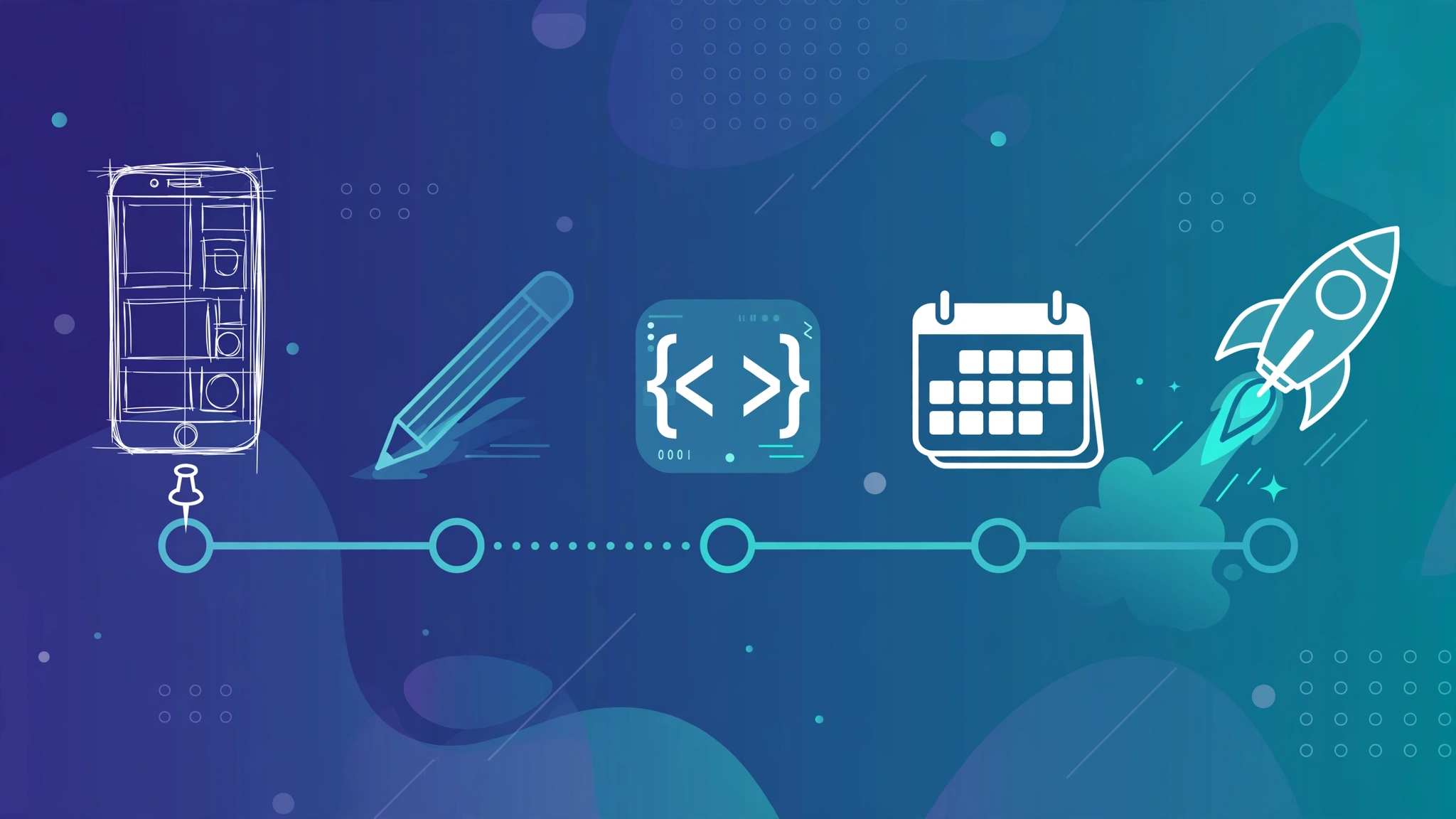

“How Long Does It Take to Build a Mobile App? Realistic Timelines”
How Long Does It Take to Build a Mobile App? Realistic Timelines
"How long will it take to build my app?" is the first question almost every client asks — and the honest answer is always "it depends on what you're building." A simple utility app and a multi-role marketplace are different projects the way a shed and a shopping mall are different buildings. This guide gives you realistic 2026 timelines by app complexity, breaks down the six phases every project goes through, and shows what actually causes delays — so you can plan a launch date with confidence instead of hope.
For the money side of the same question, see our mobile app development cost guide.
The Short Answer: Timelines by App Complexity
Complexity is the single biggest variable, and it's the one founders most often underestimate — a feature that sounds small in a pitch deck can carry backend complexity invisible from the outside. Here's how 2026 projects realistically stack up, from kickoff through app store approval:
Simple app: 2–4 months
What it includes: one core function, under ten screens, no user accounts or a very simple login, no custom backend, minimal third-party integrations. Examples: calculator-style utilities, event schedule viewers, informational apps, single-feature tools. A content app with a handful of static screens and no login can realistically ship in six to eight weeks.
Medium app / MVP: 3–6 months
What it includes: user accounts, payments, an admin panel, moderate backend logic, one or two third-party integrations. Examples: booking apps, fitness trackers, ecommerce storefronts, on-demand service apps. This is the most common band for funded startups and established businesses building their first app — and the band our MVP app development guide is written for.
Complex platform: 6–12 months
What it includes: marketplace or multi-role logic, real-time features, custom architecture, deep integrations, sometimes AI/ML components. Examples: marketplaces, logistics platforms, social networks, fintech tools with fraud detection.
Regulated / enterprise: 9–18 months
What it includes: everything above plus compliance scope (healthcare, finance, or data-protection requirements), audit trails, formal sign-off processes, and large-team coordination. Examples: telehealth platforms, banking apps, ERP mobile clients.
One important note: these timelines assume you arrive with a clear brief. If you're starting from raw idea validation, add two to four weeks for discovery and product strategy. When anyone quotes you a timeline, always ask what it's starting from — many quotes quietly exclude discovery, design, and app store review.
The Six Phases Every App Goes Through
"Development" is only one phase. Coding is typically 45–55% of the total timeline. Here's the full cycle:
Phase 1: Discovery and planning (2–6 weeks)
Defining the feature list, user flows, technical approach, and success criteria. Skipping this doesn't save time — it moves the work later, when every change touches code that already exists. This is where scope gets locked and realistic estimates get made.
Phase 2: UI/UX design (3–8 weeks)
Wireframes, visual design, and interactive prototypes. Design from scratch with multiple iteration rounds adds four to six weeks; this is normal and worth it — redesigning in code costs far more than redesigning in Figma.
Phase 3: Development (4–28 weeks depending on complexity)
The actual building: frontend, backend, APIs, integrations. Agile teams work in sprints and overlap phases to save a few weeks. This is the longest phase and the one most quotes focus on — which is why quotes that only mention "development time" mislead.
Phase 4: Testing and QA (2–8 weeks)
Testing across devices, OS versions, and screen sizes; fixing bugs; performance and security checks. Block out dedicated QA time early, not the week before launch. Rushing QA is how apps launch with the bug that defines their first hundred reviews.
Phase 5: Deployment and app store review (1–3 weeks)
Preparing store listings, screenshots, and descriptions; submitting to the App Store and Google Play; handling review feedback and rejections. Apple's review in particular can add a round-trip you didn't plan for — build buffer here.
Phase 6: Post-launch iteration (ongoing)
The launch isn't the finish line. Real user feedback reveals what to fix, simplify, or build next. Budget for at least a few weeks of post-launch fixes and improvements — the apps that succeed are the ones that keep shipping after day one.
A Worked Example: The Timeline Map
Here's what a typical medium-complexity app — say, a booking app with user accounts, payments, and an admin panel — looks like across six months:
Weeks 1–3: Discovery — feature list locked, user flows mapped, technical approach chosen (cross-platform vs native), backend architecture sketched. Weeks 4–8: Design — wireframes to polished UI, interactive prototype, two rounds of revision. Weeks 9–20: Development in two-week sprints — auth and accounts first, then booking flow, payments, admin panel, integrations; design and development overlap by two weeks. Weeks 18–22: QA runs in parallel with late development — device testing, bug fixes, performance pass. Weeks 23–24: Store submission, review buffer, launch prep. Week 25+: post-launch fixes from real user feedback.
Notice how the phases overlap: design starts before discovery fully ends, QA starts before development fully ends. That overlap — run properly, in sprints — is where professional teams save weeks without cutting corners.
What Actually Delays App Projects
On most projects, the delays that aren't development account for more slippage than the engineering does. The usual suspects:
Scope changes after design sign-off. The number-one timeline killer. Every "just add this one feature" after design touches code, tests, and sometimes the backend. Lock scope at design; new ideas go in a phase-two list.
Slow feedback loops. Designs and builds waiting days for client review stall the whole team. Agree on a 48-hour feedback turnaround before the project starts.
Third-party dependencies. Payment providers, SMS gateways, mapping APIs, client IT departments — external approvals and flaky APIs slip schedules that looked fine on paper.
Content and assets arriving late. The app is ready but the copy, images, and legal text aren't. Prepare content in parallel with development, not after.
App store rejections. Guideline violations, missing privacy disclosures, incomplete metadata — each rejection costs a review cycle. Experienced teams pre-check against the guidelines before submitting.
Undecided technical approach. Debating native vs cross-platform mid-project wastes weeks. Decide early: for most business apps in 2026, cross-platform (React Native or Flutter) cuts total build effort by roughly 20–40% versus building separate native iOS and Android apps. Go native only with a specific technical reason — deep hardware integration, extreme performance needs, or OS-level features. Our Flutter vs React Native 2026 comparison breaks down the choice.
How to Speed Up Without Cutting Corners
Start with an MVP, not the vision. Ship the smallest version that delivers real value and validates the idea — typically 6–16 weeks — then build on what users actually want. The year-two feature list is not a launch requirement.
Lock the feature list before design. A frozen scope is the fastest schedule protection that exists.
Choose cross-platform early. One codebase for iOS and Android unless you have a concrete reason not to.
Use proven third-party services. Auth, payments, push notifications, analytics — don't rebuild solved problems.
Keep feedback fast. Same-week reviews on every design and build milestone.
Add a 10–15% buffer. Something always surprises you. Planning for it isn't pessimism; it's how launches land on time.
FAQs
What is the average time to build a mobile app?
Most business apps take 3–9 months from kickoff through app store approval. Simple apps land at 2–4 months, medium apps at 4–7 months, complex platforms at 7–12 months, and regulated or enterprise apps at 9–18 months. The "average" hides the spread — find the complexity tier that matches your feature list, not your ambition.
Can an app be built in one month?
A proof-of-concept, a no-code prototype, or an extremely simple utility — yes. A fully developed app with proper UX, testing across devices, backend, and store deployment — no. Anyone promising a real app in weeks is either quoting a prototype or planning to cut the phases (testing, QA, review buffer) where quality lives.
Does building for both iOS and Android double the timeline?
Not with cross-platform development. React Native or Flutter let one codebase target both platforms, cutting total effort by roughly 20–40% compared to two separate native builds. Building two fully native apps is close to — though not quite — double the work, since design, backend, and planning are shared.
How long does app store approval take?
Google Play review is usually fast — hours to a few days. Apple's App Store review typically takes one to several days, longer if there are rejections to address. Budget one to three weeks for the whole deployment phase including listing preparation and at least one potential review round-trip.
What slows down app development the most?
Scope changes after design sign-off, slow client feedback, third-party API and approval delays, late content, and app store rejections. In practice these non-development delays cause more slippage than the engineering itself — which is why disciplined scoping and fast feedback matter more than raw coding speed.
How much does it cost to build an app, relative to the timeline?
Cost tracks complexity the same way time does — the two move together closely enough that a quote promising a complex build on a simple-app schedule is usually mispriced as well as misjudged. As a starting reference, professional mobile app development starts from $3,500, with the final figure fixed in a quote after a free consultation based on your feature list.
Get a Realistic Timeline for Your App Idea
Generic ranges only go so far — your timeline depends on your feature list, your platforms, and your launch constraints. We'll map your idea to a realistic phase-by-phase timeline and a fixed quote, starting from $3,500 for mobile app development. Get a free consultation and leave with a launch date you can actually plan around.
Santol Edge Team
AuthorWrites extensively about generative AI, autonomous agent design, enterprise automation architectures, and customer experience engineering at Santol Edge.
Read Next

How AI Automation Helps Modern Businesses Scale 10x Faster
Discover how forward-thinking companies are deploying intelligent agents and automated pipelines to reduce overhead and boost revenue.

How AI Chatbots Transform Customer Support and Business Growth
Learn how AI chatbots improve customer response times, qualify leads, support teams, and create more consistent customer experiences.

AI Voice Agents: What They Are and How They Work
Understand where voice agents add value, how they connect with business systems, and what to consider before launching one.
Community Comments (0)
Sep 26, 2026Elisa Gabriella
VP of Operations · BrightSync
“A genuinely useful piece — the point about consolidating thin pages matches what we saw on our own platform last year. Deploying automated workflows cut roughly half our manual ticket volume and resolution speed went up significantly.”
Leave a Reply
Your email address will not be published. Required fields are marked *