
Santol Edge Team
AI Research & Engineering at Santol Edge
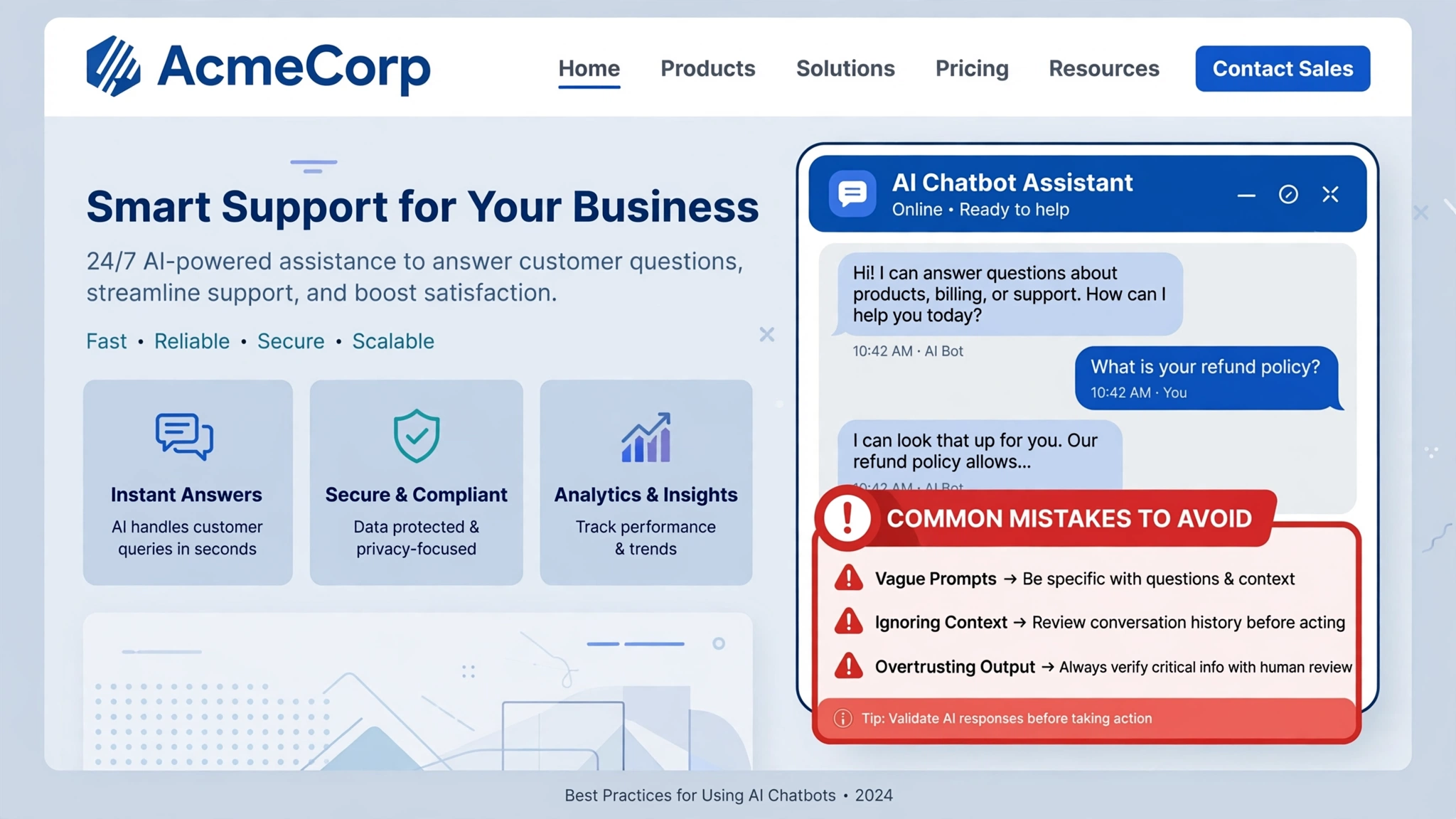

“Common Chatbot Mistakes That Kill Conversions (and How to Fix Them)”
Common Chatbot Mistakes That Kill Conversions (and How to Fix Them)
If your chatbot is installed, online, and answering questions — but barely generating leads or sales — here is the short answer: it is almost always the setup, not the technology. The AI model underneath is fine. The way the bot was configured — what it says first, when it pops up, what it asks for, and what happens when it fails — is what decides whether visitors become customers or close the chat window.
Across service businesses, coaches, agencies, and local companies, the same patterns repeat. Below are the nine mistakes that kill chatbot conversion rates, ordered roughly by how much damage they do, with the practical fix for each. At the end you will find a 7-day fix plan so you know exactly where to start.
Mistake 1: No Clear Conversion Goal
What it looks like in practice: The bot opens with "Hi! How can I help you today?" and then waits. It is a generic assistant with no destination — it can answer FAQs, but it never moves anyone toward booking a call, requesting a quote, or buying.
Why it costs conversions: A chatbot without a defined goal is just a friendlier search bar. Visitors with buying intent never get routed to the next step because the bot was never told what the next step is.
The fix: Give every chatbot flow exactly one conversion goal. For most service businesses that goal is simple: get the visitor to book a call, request a quote, or leave contact details with a clear reason. Everything in the conversation — the greeting, the questions, the buttons — should point at that one goal. If you serve multiple audiences, create separate flows per page or service, each with its own single goal.
A good rule of thumb for any implementation: if you cannot state the bot's goal in one sentence, it does not have one. Fix this first — it multiplies the effect of every other fix.
Mistake 2: The Bot Pops Up Too Early (Trigger Spam)
What it looks like in practice: The chat window slides open three seconds after the page loads, before the visitor has read a single headline. On mobile it covers the content. Some sites fire it on every page visit.
Why it costs conversions: A chatbot that interrupts before a visitor has formed intent collects noise, not leads. It annoys the people most likely to convert — the careful readers — and trains everyone else to hit the X reflexively.
The fix: Trigger on intent signals, not on time alone. Good options: exit-intent on desktop, 45–60 seconds on page, scroll depth (60%+), a click on a pricing or contact section, or return visits. And keep the proactive message short and page-specific: on a pricing page, "Questions about the plans? I can compare them for you" will always beat a generic greeting.
Mistake 3: Weak Training Data
What it looks like in practice: The bot gives accurate-sounding but generic answers — the kind you would get from a general AI, not from your business. It cannot explain your pricing properly, mixes up your services, or answers with vague filler because it was trained on a thin FAQ page instead of your real business knowledge.
Why it costs conversions: Visitors can smell a generic answer instantly. The moment the bot gets something wrong about your own offering, trust collapses — and a visitor who does not trust the bot will not trust the business behind it.
The fix: Train the bot on your real knowledge base: your service descriptions, pricing pages, booking policies, refund terms, past customer emails, and the answers your best staff give every day. Then review real conversation transcripts weekly and add the questions the bot failed to answer well. Training is not a one-time task — it is a weekly habit. For a full walkthrough, see our guide on how to train an AI chatbot on your business data.
Mistake 4: Asking for Contact Details Too Early
What it looks like in practice: The second message is "What's your name and email?" — before the bot has answered a single question or given the visitor any reason to share personal information.
Why it costs conversions: Nobody hands over their email to a stranger. Asking before delivering value feels like a toll booth, and most visitors simply leave.
The fix: Deliver value first. Answer a question, show a relevant recommendation, or give something useful — then ask for contact details with a reason attached: "Want me to send you the full quote breakdown? What's the best email?" The rule is simple: the ask should feel like a favor the visitor is happy to do, not a price of admission.
Mistake 5: No Human Handoff
What it looks like in practice: The bot hits its limits, repeats "I don't understand," loops the same answer, or goes silent — and there is no way to reach a human. The conversation just dies.
Why it costs conversions: The visitors who most need a human are the ones with the highest intent: complicated questions, objections, edge cases, "this is urgent" situations. When those people hit a dead end, they do not complain — they leave, quietly, and usually to a competitor.
The fix: Set smart handoff triggers: keywords like "speak to someone," "human," "agent," or "call me"; repeated failed answers in one conversation; sentiment that reads frustrated; or high-intent signals such as pricing negotiation. Make the handoff smooth — pass the full conversation to the human so the visitor never repeats themselves. For an honest comparison of both channels, read AI chatbot vs live chat.
Mistake 6: Robotic Language and Overly Long Flows
What it looks like in practice: Stiff, corporate phrasing. Menus ten options deep. Twenty questions before any answer. Or the opposite extreme — walls of text in a single bubble that nobody reads on a phone.
Why it costs conversions: People abandon boring. A chatbot should feel like texting a helpful colleague, not filling out a government form. Long, rigid flows create drop-off at every extra step.
The fix: Write the bot's script the way a person talks: short messages, one question per message, quick-reply buttons instead of open typing wherever possible. Map the ideal path and cut every step that is not strictly necessary — collect the minimum upfront (name + one contact method), and gather the rest after the conversion. Test every flow on a phone; if it feels tedious there, it is.
Mistake 7: Treating Every Visitor the Same
What it looks like in practice: One bot, one script, for the homepage, the pricing page, the blog, paid ad landing pages, and returning customers. The person reading a "book a demo" page gets the same greeting as someone skimming a blog post.
Why it costs conversions: Context is free and you are throwing it away. A visitor on your pricing page is ten times warmer than one on your homepage — but your bot talks to both identically, so the warm visitor never gets the buying conversation they were ready for.
The fix: Use page-specific greetings and simple conditional branches. Pricing page: offer plan comparisons. Service page: offer the booking step for that service. Blog: offer the related lead magnet or consultation. Return visitor: acknowledge them ("Welcome back — still looking for help with X?"). This needs no advanced AI — just basic routing logic. It is one of the highest-ROI changes you can make.
Mistake 8: The Premature Hard CTA
What it looks like in practice: "Ready to buy? Click here to checkout!" as the second message. The bot pushes the sale before it has qualified the visitor, answered a question, or earned any interest.
Why it costs conversions: A hard CTA to a cold visitor feels pushy and triggers the same defensive reaction as an aggressive salesperson. You get the click from no one and lose the trust of everyone.
The fix: Earn the CTA. Qualify first (what do they need, what's their situation), give value (answer, recommend, explain), and only then offer the next step — framed as help, not pressure: "Based on what you told me, this is the option that fits. Want me to book you a free 15-minute call to go through it?" Proven qualification flows are covered in our chatbot lead qualification scripts guide.
Mistake 9: Never Reviewing Transcripts or Measuring Outcomes
What it looks like in practice: The bot launched six months ago and nobody has looked at a conversation since. The dashboard shows "conversations completed" and everyone assumes it is working. It is not.
Why it costs conversions: A chatbot is not a crockpot — you cannot set it and forget it. Language changes, your services change, visitors ask new questions. Without measurement, every other fix in this article degrades back into a mistake within months.
The fix: Do two things. First, measure the metric that matters: conversations that turned into leads, bookings, or sales — not conversation counts or completion rates, which are vanity metrics. Second, review a batch of real transcripts every week: find where visitors dropped off, which questions the bot answered badly, and fix the top issue each week. One fix per week compounds fast.
The 7-Day Fix Plan (Priority Order)
Do not try to fix all nine at once. Start with the mistake doing the most damage and work down:
Day 1 — Define the goal. Write one sentence: "This bot exists to get visitors to ___." If you cannot, decide it now. (Fixes Mistake 1)
Day 2 — Fix the triggers. Change when and where the bot fires: intent-based triggers and page-specific greetings. (Fixes Mistakes 2 and 7)
Day 3 — Shorten the flow. Cut questions, add quick replies, one message per idea. Test on your phone. (Fixes Mistake 6)
Day 4 — Move the ask. Push contact capture behind the value delivery; rewrite the ask with a reason. (Fixes Mistake 4)
Day 5 — Add the human handoff. Set triggers, connect the notification, test the handoff yourself. (Fixes Mistake 5)
Day 6 — Soften the CTA. Rewrite your closing as help, not pressure; qualify before pitching. (Fixes Mistake 8)
Day 7 — Feed it real data + set up weekly reviews. Upload your real business knowledge, read last week's transcripts, and schedule the weekly review. (Fixes Mistakes 3 and 9)
Seven days, one focused change per day. For most businesses, fixing the top three alone produces a visible change in lead quality within the first couple of weeks.
FAQs
Why is my chatbot not converting even though it gets a lot of chats?
High chat volume with low conversion almost always points to a missing conversion goal or an early-contact-capture setup. The bot is collecting conversations instead of routing intent. Start by giving each flow one clear goal and moving the contact ask behind value delivery.
What is a good chatbot conversion rate?
It depends on the industry and the goal — industry guides typically report that well-tuned lead-generation chatbots convert a meaningful share of engaged conversations into leads, while poorly configured ones convert almost none. The honest benchmark is your own trend: track conversations-to-outcomes weekly and improve from your baseline, not someone else's number.
Should my chatbot try to sound human?
It should sound natural and conversational, but it should never pretend to be a person. Be upfront that it is an AI assistant, write in a friendly short-message style, and offer a human handoff — pretending to be human destroys trust the moment it slips.
How many questions should my chatbot ask before capturing a lead?
As few as possible. Collect the minimum needed to follow up (usually a name and one contact method) after you have delivered value. Every extra question before the conversion costs you drop-offs — gather the rest after the lead is captured.
Is it better to rebuild my chatbot or fix the existing one?
In most cases, fix it. These nine mistakes are configuration problems — goals, triggers, training data, flows — not technology problems. A rebuild without changing the setup decisions that caused the problem just recreates the same chatbot with new software.
Want Your Chatbot Fixed Properly?
If your chatbot is installed but not producing, the fastest path is a professional review: audit the flows, fix the triggers, train it on your real business data, and wire up the human handoff and measurement. Santol Edge builds and fixes AI chatbots that are set up to convert from day one — and if you would like to see what the investment looks like first, read our breakdown of AI chatbot development costs. Get a free consultation and we will tell you honestly whether your bot needs a tune-up or a rebuild.
Santol Edge Team
AuthorWrites extensively about generative AI, autonomous agent design, enterprise automation architectures, and customer experience engineering at Santol Edge.
Read Next

How AI Automation Helps Modern Businesses Scale 10x Faster
Discover how forward-thinking companies are deploying intelligent agents and automated pipelines to reduce overhead and boost revenue.

How AI Chatbots Transform Customer Support and Business Growth
Learn how AI chatbots improve customer response times, qualify leads, support teams, and create more consistent customer experiences.

AI Voice Agents: What They Are and How They Work
Understand where voice agents add value, how they connect with business systems, and what to consider before launching one.
Community Comments (0)
Sep 26, 2026Elisa Gabriella
VP of Operations · BrightSync
“A genuinely useful piece — the point about consolidating thin pages matches what we saw on our own platform last year. Deploying automated workflows cut roughly half our manual ticket volume and resolution speed went up significantly.”
Leave a Reply
Your email address will not be published. Required fields are marked *