
Santol Edge Team
AI Research & Engineering at Santol Edge

“How to Automate Your Sales Pipeline with AI (2026 Guide)”
How to Automate Your Sales Pipeline with AI (2026 Guide)
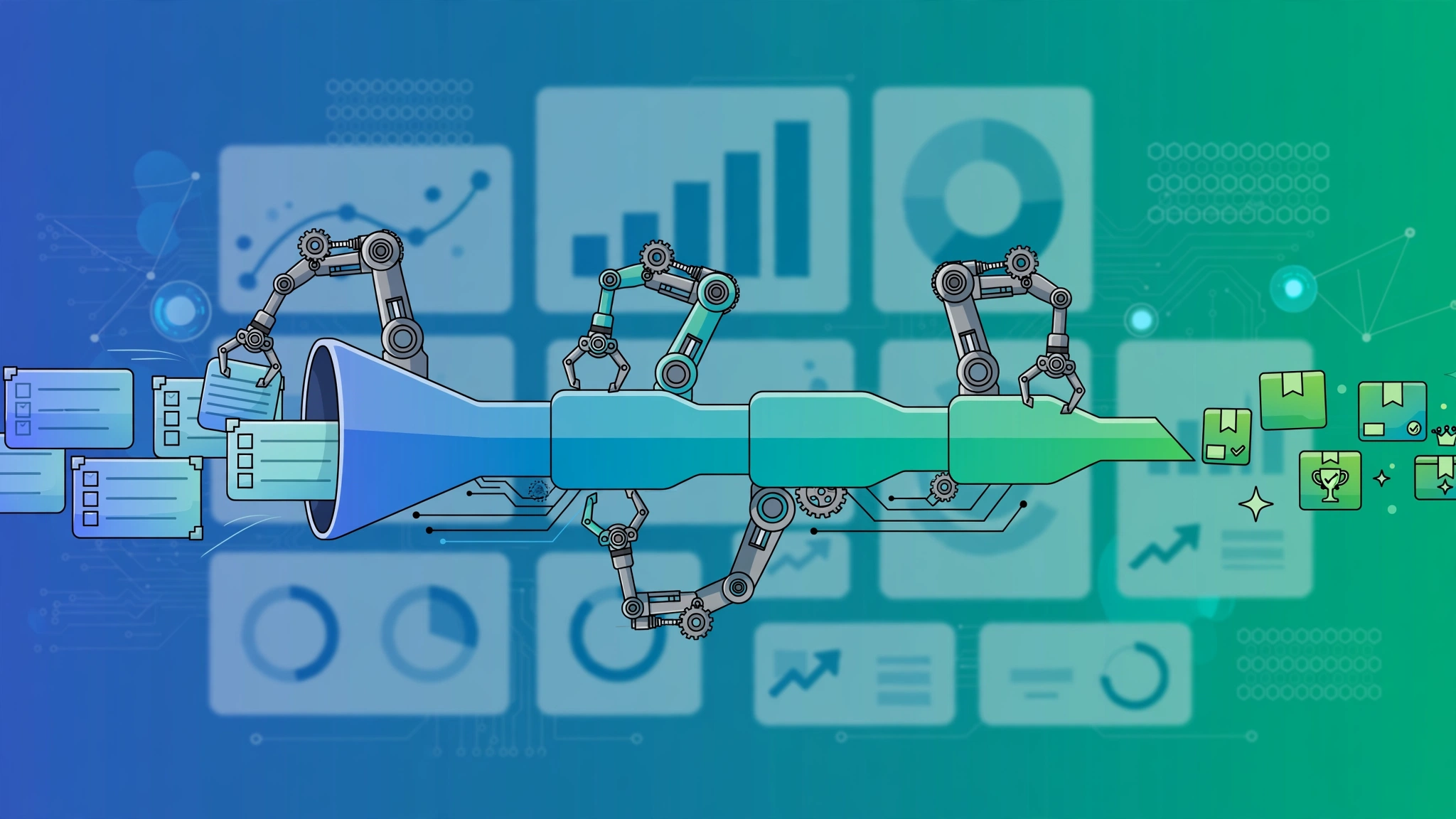
Most sales pipelines leak in the same places: leads sit unanswered for hours, follow-ups depend on someone's memory, the CRM is half-empty, and stalled deals get discovered weeks too late. AI pipeline automation fixes the plumbing — the repetitive, time-sensitive work between stages — so your reps spend their hours selling instead of administrating. This guide walks through the pipeline stage by stage, shows what to automate at each one, and flags the mistakes that make automation projects fail.
The goal is a system that moves leads on its own and pulls in a human only when judgment matters. For the economics of that, see our AI automation ROI guide.
Start Here: Map Your Actual Pipeline First
Before automating anything, write down what your pipeline actually looks like — not the idealized version in your CRM, but what happens in real deals. Most teams discover two or three informal stages that were never in the system. Automations built on a fictional pipeline fire at the wrong moments.
A typical small-business pipeline has five to seven stages: New Lead → Qualified → Meeting Booked → Proposal Sent → Negotiation → Closed (Won/Lost). Walk your last ten deals through it. Note where deals stall, where follow-ups got missed, and which stages depend on someone remembering to do something. Those are your automation targets, ranked by pain.
Stage 1: Lead Capture and Instant Response
The highest-ROI automation in most pipelines is also the simplest: respond to every new lead instantly, automatically. Leads from your website form, ads, email inquiries, and referrals should be captured into your CRM the moment they arrive, and the first touch should go out within minutes — not when a rep gets around to it.
What to automate:
Multi-channel capture. Every form, inbox, and ad lead source writes to one CRM with no manual entry. Missed calls can trigger an automatic text-back so the lead isn't lost.
Instant first response. An automated email or SMS acknowledging the inquiry, plus — for high-intent leads — an AI voice call within minutes. Speed-to-lead is consistently the highest-return use case because the prospect is still thinking about the problem.
Rep notification. The assigned rep gets an instant alert with the lead's details, so the human follow-up starts warm instead of cold.
This stage is pure workflow automation — fixed steps, structured input, near-zero per-run cost. It is also the foundation everything else stands on: no automation downstream works if leads aren't captured cleanly here.
Stage 2: Qualification and Lead Scoring
Not every lead deserves a rep's time. AI qualification separates the serious from the curious automatically.
What to automate:
AI lead scoring. Score each lead against your best-customer profile — industry, company size, budget signals, timeline, source. Start with five to seven criteria, not twenty; a bloated scoring model is worse than a simple one. Work backward from your closed-won deals: what did your best customers have in common?
Conversational qualification. A chatbot or AI voice agent asks the qualifying questions naturally — what they need, their timeline, their budget range — and records structured answers back to the CRM. This replaces the "discovery call that wasn't really a discovery call."
Smart routing. Qualified leads route to the right rep by territory, deal size, or specialty, with enterprise or high-value leads escalating to senior reps automatically.
The rule: automate the information gathering, keep the relationship building human. Gathering facts doesn't require judgment; interpreting them in a sales conversation does. Our chatbot lead qualification scripts guide shows the exact question flows that work.
Stage 3: Follow-Up Sequences That Never Forget
This is where most pipelines actually die. A rep means to follow up, gets busy, and the deal goes cold. Automated follow-up sequences remove memory from the equation.
What to automate:
Behavior-triggered sequences. Quote viewed but no reply in 48 hours → check-in message. Demo completed → next-step email with calendar link. Proposal opened three times → alert the rep that buying intent is spiking. The sequence adapts to what the prospect does, not just how much time passed.
Multi-channel follow-up. Email, SMS, and voice in a coordinated sequence — each channel reinforcing the others, with replies in any channel pausing the rest.
Long-term nurture. "Not right now" leads enter a nurture track with useful content and periodic check-ins, so they're warm when timing changes instead of starting from zero.
Keep a human review before anything customer-facing goes out, at least in the early months. AI drafts; reps approve. That single gate prevents the tone-deaf automated message that costs you a deal. For the full playbook, read our AI lead follow-up automation playbook.
Stage 4: Meeting Booking Without the Email Tennis
Scheduling is pure friction: "Does Tuesday work?" "No, how about Thursday?" "Morning or afternoon?" Automate it away.
What to automate:
Self-serve booking. Qualified leads get a booking link with live availability — no back-and-forth. The booking writes to the calendar, the CRM, and triggers confirmations.
AI-scheduled booking. For warmer conversations, an AI agent can offer slots conversationally — in chat, by email, or on a call — and book before hanging up.
Reminders and rebooking. Confirmation at booking, reminder 24 hours before, and instant rebooking when plans change. This is the machinery behind serious no-show reduction.
Stage 5: Proposal, Negotiation, and Closing Support
Later stages need a lighter touch — this is where human judgment earns its keep — but AI still removes real work:
Proposal generation. Pull opportunity data, product specs, and pricing from your systems into a draft proposal automatically. The rep reviews and personalizes instead of starting from a blank page.
Stakeholder tracking. Log every interaction, email open, and document view against the deal automatically. When the champion goes quiet, the system flags which other stakeholders engaged — so the rep knows who to call.
Stalled-deal alerts. Deal sitting in one stage past your normal cycle time? The system escalates to the rep and then the manager with context, instead of the stall being discovered at the end of the quarter.
Contract and e-signature. Generate the contract from the agreed terms and route it for signature without manual document assembly.
Stage 6: The Analytics Layer (Don't Skip This)
Automation without measurement is just faster chaos. Build a live view of:
Pipeline by stage — where deals sit right now, and how long each stage takes on average.
Conversion rates between stages — where the biggest drop-offs happen. That's your next automation target.
Response-time metrics — how fast new leads get touched, and how that correlates with close rates.
Forecast accuracy over time — so the pipeline becomes a planning tool, not a wish list.
This layer is what turns a set of automations into a system: every month, the data tells you which stage to improve next.
A Worked Example: The Pipeline Map
Here's what this looks like for a typical service business — say, a B2B agency getting 100 inbound leads a month:
New Lead → instant SMS + email acknowledgment; CRM record created; rep notified. → Qualified → AI chatbot asks budget/timeline/need; score computed; hot leads (score 70+) routed to senior rep with an instant call task; warm leads enter a nurture sequence. → Meeting Booked → self-serve calendar link for warm leads, AI-scheduled call for hot ones; confirmation + 24h reminder automated. → Proposal Sent → draft generated from opportunity data; rep personalizes and sends; view-tracking triggers a 48h check-in if unopened, and a "questions?" call if opened repeatedly. → Negotiation → stalled-deal alerts at 14 days; stakeholder engagement logged automatically. → Closed → won deals trigger onboarding tasks; lost deals enter a 90-day re-engagement track.
Notice what the humans do in this map: run the meetings, personalize the proposals, negotiate, close. Everything else — the remembering, the routing, the reminding, the logging — is machinery.
Common Pitfalls (and How to Avoid Them)
Pitfall 1: Automating a broken process. If your stages are undefined or your reps don't trust the CRM data, automation just executes the mess faster. Map and clean the process first — an AI automation audit is designed exactly for this.
Pitfall 2: Trying to automate everything at once. Teams that overhaul the entire pipeline in one sprint usually end up back on spreadsheets within weeks. Start with lead capture and one follow-up sequence. Get it working. Then expand.
Pitfall 3: Over-automation killing personalization. Generic AI outreach gets ignored. Use AI for scale and research; keep the first human touch genuinely personal. AI finds and warms; humans connect.
Pitfall 4: Garbage data in. AI scoring and routing are only as good as the CRM data feeding them. Clean and standardize before you automate, and keep reps logging activity correctly — or automate the logging itself.
Pitfall 5: No human gates on customer-facing output. Letting AI send messages, quotes, or proposals unsupervised because the demo looked smooth. Keep rep review in front of anything the customer sees until the system has proven itself on real volume.
What Does Sales Pipeline Automation Cost?
Honest answer: it depends on how many stages you automate, but the core building blocks have fixed, published prices. At Santol Edge: an AI Automation Audit (which maps your pipeline and identifies exactly what to automate first) is $149; Lead Qualification Automation is $699; Appointment Booking Automation is $799; CRM Automation Setup (capture, routing, logging, stage triggers) is $999 — all one-time. Ongoing monitoring, support, and monthly improvements run $299–$999/month. Anything beyond these packages is a fixed quote after a free consultation.
FAQs
Will AI sales automation replace my sales reps?
No. It replaces administrative work, not relationships. Reps who use automation spend their time on discovery, negotiation, and closing — the work that actually needs a human. Reps who ignore it spend their time on data entry and forgotten follow-ups. The automation handles the plumbing; the humans handle the persuasion.
What part of the sales pipeline should I automate first?
Lead capture with instant response, then follow-up sequences. They are high-volume, rule-based, and produce visible wins fast — which builds your team's trust in automation. Qualification and scoring come next; proposal and analytics tooling after that.
How long does it take to set up sales pipeline automation?
A first stage (capture + instant response) can be live in days to a couple of weeks. A full multi-stage pipeline typically rolls out over four to eight weeks when done in phases. Anyone promising the entire pipeline automated overnight is skipping the mapping and testing that make it actually work.
Do I need to change my CRM to automate my pipeline?
Usually not. Most modern CRMs (HubSpot, Salesforce, Pipedrive, Zoho) have automation engines and APIs that AI tools can build on. The more common requirement is cleaning up the data and stages inside the CRM you already have — which is part of what an automation audit covers.
Can AI automate follow-up without sounding robotic?
Yes, with two conditions: the messages must be templated from your real voice (not generic AI copy), and a human should review customer-facing output in the early months. Behavior-triggered follow-up — reacting to what the prospect actually did — also feels far more natural than time-based drip sequences.
How do I measure whether pipeline automation is working?
Track response time to new leads, follow-up completion rates, conversion rates between stages, average days per stage, and ultimately revenue per rep. Compare against your pre-automation baseline. If response time drops and stage conversion rises, the machinery is earning its keep.
Ready to Stop Leaking Deals?
Every pipeline leaks somewhere — the question is whether it's slow response, forgotten follow-up, or messy data. Our $149 AI Automation Audit maps your pipeline stage by stage and tells you exactly what to automate first, in what order. From there, qualification ($699), booking ($799), and CRM automation ($999) are fixed, published packages. Get a free consultation and we'll find your biggest leak together.
Santol Edge Team
AuthorWrites extensively about generative AI, autonomous agent design, enterprise automation architectures, and customer experience engineering at Santol Edge.
Read Next

How AI Automation Helps Modern Businesses Scale 10x Faster
Discover how forward-thinking companies are deploying intelligent agents and automated pipelines to reduce overhead and boost revenue.
How AI Chatbots Transform Customer Support and Business Growth
Learn how AI chatbots improve customer response times, qualify leads, support teams, and create more consistent customer experiences.

AI Voice Agents: What They Are and How They Work
Understand where voice agents add value, how they connect with business systems, and what to consider before launching one.
Community Comments (0)
Sep 26, 2026Elisa Gabriella
VP of Operations · BrightSync
“A genuinely useful piece — the point about consolidating thin pages matches what we saw on our own platform last year. Deploying automated workflows cut roughly half our manual ticket volume and resolution speed went up significantly.”
Leave a Reply
Your email address will not be published. Required fields are marked *