
Santol Edge Team
AI Research & Engineering at Santol Edge
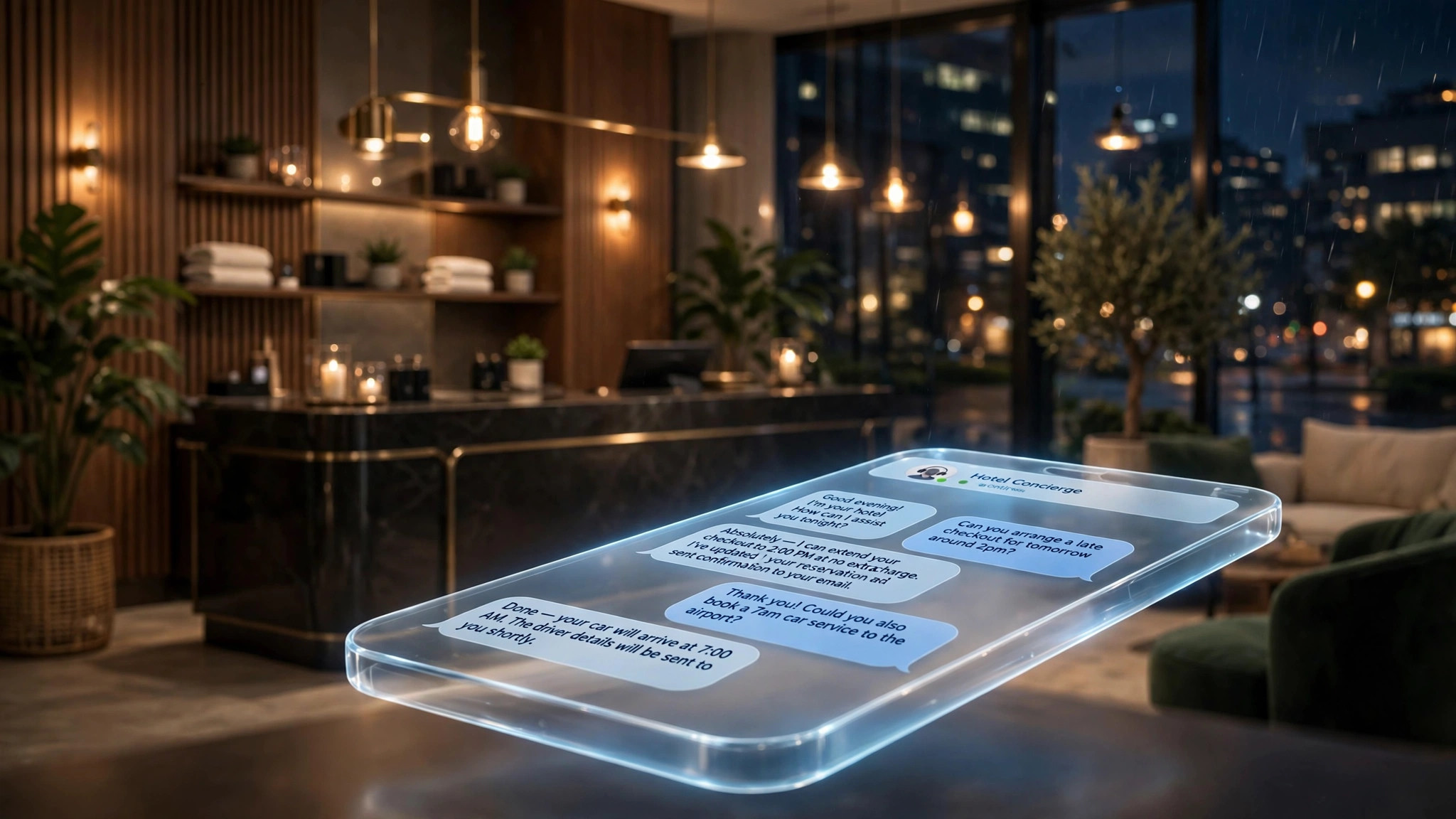

“AI Chatbots for Hotels: Turn Website Visitors Into Direct Bookings (2026 Guide)”
AI Chatbots for Hotels: Turn Website Visitors Into Direct Bookings
Your hotel website gets visitors. But most of them leave without booking — they bounce to an online travel agency, or they simply never get their question answered in time. Check-in times, parking, pet policies, pool hours, whether the breakfast menu suits their dietary needs: small questions decide real bookings, and they arrive at all hours from every time zone.
An AI chatbot for hotels answers those questions instantly, right on your website and on WhatsApp, and guides the guest toward booking direct instead of through a commission-charging OTA. This guide walks through what a hotel chatbot actually does day to day, how it shifts the economics away from OTA dependence, and what to check before you buy one — written for hotel owners and GMs, not developers.
Why Hotels Lose Direct Bookings
The average hotel website converts a small fraction of its visitors. The rest leave for reasons that have nothing to do with price:
Unanswered questions. A guest wants to know if the hotel has parking, or whether the pool is open in October, or if dogs are allowed. Nobody answers at 11 PM. The guest books on Booking.com instead — where the answer was visible.
Friction in the booking flow. If the path from "interested" to "booked" takes more than a couple of steps, guests bail. OTAs have spent billions removing friction; most hotel websites haven't.
Language barriers. International guests browse in their own language. If your site and your staff can't answer in it, the guest goes where someone can.
No follow-up. A visitor checks rates, leaves, and never comes back. Hotels rarely have the machinery to re-engage that visitor the way OTAs do with retargeting.
An AI chatbot attacks all four: it answers instantly in the guest's language, it can walk the guest to the booking engine, and it captures the details of the ones who don't book so you can follow up.
What a Hotel Chatbot Does Day to Day
A hotel chatbot trained on your property data handles the conversations your front desk currently repeats dozens of times a day:
Pre-booking questions. Room types and what's included, rates and seasonal pricing, check-in/check-out times, cancellation policy, parking, Wi-Fi, pool and spa hours, pet policy, breakfast options. The chatbot answers from your actual rate cards and policies — not guesses.
Booking assistance. When the guest is ready, the chatbot routes them to your booking engine with the right dates and room type pre-contextualized — or hands the conversation to your reservations team with a full summary.
Upselling and add-ons. Late checkout, room upgrades, spa treatments, airport transfers, restaurant reservations. The chatbot offers these naturally in the conversation, at the moment the guest is most receptive.
Post-booking support. "Can I add a cot?" "Is there a shuttle from the airport?" "What time does the restaurant close on Sundays?" The chatbot handles these without a phone call.
Review requests. After checkout, automated follow-ups ask for a review at the right moment — when the stay is fresh.
WhatsApp: The Channel Guests Actually Use
Most hotel guests don't want to call your front desk, and many don't want to fill out a contact form either. They message on WhatsApp — the same way they message friends. A hotel chatbot on WhatsApp can:
Answer pre-booking questions in the guest's language, 24/7
Send booking confirmations, pre-arrival info, and check-in instructions
Handle mid-stay requests: extra towels, restaurant bookings, late checkout
Send checkout reminders and review requests
WhatsApp setup requires the WhatsApp Business API (not the free Business App) for proper chatbot integration, plus Meta verification of your business number. It's a real project — but for hotels, it's where the guests are.
PMS Integration: The Difference Between a Gimmick and a Tool
A chatbot that can only answer FAQs is a nicer FAQ page. A chatbot connected to your Property Management System can check real availability, quote real rates, and create real reservations. Before you buy, ask:
Which PMS platforms does it integrate with? (Opera, Cloudbeds, Mews, and others are common.)
Can it check live availability and pricing? If not, it's just deflecting to your booking engine.
Does it write back to the PMS? Reservations, guest notes, and preferences should flow into your system — not live in a separate chat log.
What happens when it can't help? The chatbot should hand off to your front desk with the full conversation history attached.
Integration quality is what separates a hotel chatbot that drives revenue from one that just looks modern.
Multilingual Support: Your Guests Don't All Speak English
International travel runs on dozens of languages. A hotel chatbot that handles the guest's language — answering questions, confirming bookings, sending pre-arrival info in it — removes one of the biggest reasons international guests book through an OTA instead of direct. Ask how the provider trains and tests the chatbot in your key guest languages, and how it handles the handoff when a conversation goes beyond what the bot can do in that language.
The Economics: OTAs vs Direct
OTA commissions typically run 15–25% per booking. For an independent hotel doing even a modest volume of direct-capable traffic, shifting a share of bookings from OTAs to direct pays for a chatbot many times over. The chatbot is a fixed one-time project cost — the AI Website Chatbot is $499 one-time — while OTA commissions are a forever tax on every booking. Run the numbers on your own commission spend and the payback window is usually short.
Launch Checklist
Before your hotel chatbot goes live:
Load your real data. Rate cards, room descriptions, policies, FAQs, local recommendations. The chatbot is only as good as its training data.
Connect your booking engine and PMS. Test real availability checks and reservation flows end to end.
Set up WhatsApp. Business API, verified number, templates approved.
Define the handoff. Which questions go to the front desk, and how does the chatbot hand them over?
Test in your guest languages. Run real conversations in each language you promise.
Set up review follow-ups. Post-checkout automation is part of the value — don't launch without it.
Our Fixed Prices
AI Website Chatbot — $499 one-time
AI Voice Agent Setup — $1,200 one-time (for phone reservations)
AI Automation Audit — $149 one-time
Support plans — $299–$999/month
Anything else is a fixed quote after a free consultation. All pricing in USD.
Frequently Asked Questions
How much does a hotel chatbot cost?
An AI Website Chatbot is $499 one-time. PMS integrations and WhatsApp setup are scoped as fixed quotes after a free consultation. Ongoing support plans run $299–$999/month.
Will it integrate with our PMS?
That's the key question to ask any provider. Confirm compatibility with your specific PMS (Opera, Cloudbeds, Mews, etc.) before you commit — integration quality determines whether the chatbot drives bookings or just answers FAQs.
Can guests book directly through the chatbot?
The chatbot guides guests to your booking engine with context, and with PMS integration it can check live availability and create reservations. Confirm exactly what the booking flow looks like in a demo before you buy.
Does it work on WhatsApp?
Yes — via the WhatsApp Business API with a verified business number. This is the channel many hotel guests prefer, for pre-booking questions and mid-stay requests alike.
What languages can it handle?
Modern chatbots handle many languages. Tell the provider which languages your guests use most and test real conversations in each before launch.
What happens when the chatbot can't answer?
It hands off to your front desk or reservations team with the full conversation history attached. You reply in your own time; the guest never feels dropped.
Will it reduce our OTA commissions?
It can — by converting more website visitors into direct bookings and re-engaging visitors who would otherwise book on an OTA. The economics depend on your traffic and commission rates, but the payback math is usually favorable.
How long does setup take?
Typically a few weeks: loading your property data, connecting the booking engine/PMS, setting up WhatsApp, and testing. Your timeline depends on integration complexity.
Turn More Website Visitors Into Direct Bookings
Every unanswered question on your website is a booking that goes to an OTA — with a 15–25% commission attached. An AI chatbot answers instantly, in your guest's language, around the clock, and guides them to book direct. Setup is a fixed $499 one-time, trained on your actual property data.
Contact us for a free consultation and a fixed quote for your hotel.
Santol Edge Team
AuthorWrites extensively about generative AI, autonomous agent design, enterprise automation architectures, and customer experience engineering at Santol Edge.
Read Next

How AI Automation Helps Modern Businesses Scale 10x Faster
Discover how forward-thinking companies are deploying intelligent agents and automated pipelines to reduce overhead and boost revenue.
How AI Chatbots Transform Customer Support and Business Growth
Learn how AI chatbots improve customer response times, qualify leads, support teams, and create more consistent customer experiences.
AI Voice Agents: What They Are and How They Work
Understand where voice agents add value, how they connect with business systems, and what to consider before launching one.
Community Comments (0)
Sep 30, 2026Elisa Gabriella
VP of Operations · BrightSync
“A genuinely useful piece — the point about consolidating thin pages matches what we saw on our own platform last year. Deploying automated workflows cut roughly half our manual ticket volume and resolution speed went up significantly.”
Leave a Reply
Your email address will not be published. Required fields are marked *