
Santol Edge Team
AI Research & Engineering at Santol Edge
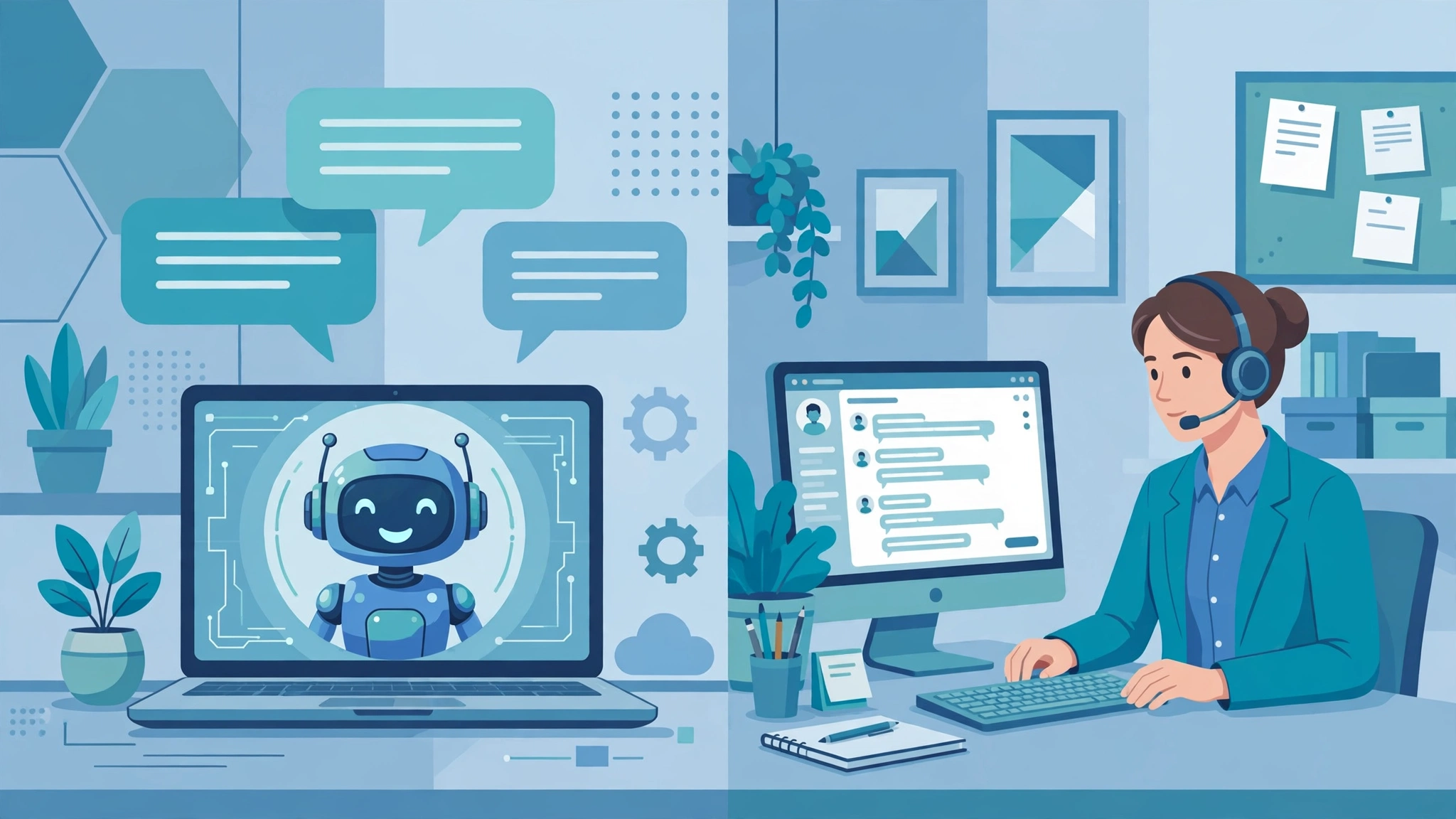

“AI Chatbot vs Live Chat: Which Is Better for Your Business in 2026?”
AI Chatbot vs Live Chat: Which Is Better for Your Business in 2026?
The AI chatbot vs live chat debate comes up in almost every conversation we have with business owners. You want someone — or something — answering your website visitors instantly. A human agent gives you the personal touch. An AI chatbot gives you speed, 24/7 coverage, and a flat cost. So which one is actually better for your business in 2026?
The honest answer: most businesses no longer have to choose. The best-performing setups combine both — an AI chatbot that handles the routine conversations and hands off to a human when judgment matters. But to build that setup, you need to understand what each option really does, where each one wins, and what each one costs. Let's break it down.
The Short Answer
If you only read one section, read this: an AI chatbot is better for speed, availability, cost, and lead capture at scale. Live chat with a human agent is better for complex problems, emotional situations, and high-value sales conversations.
For most small and mid-sized businesses, the winning setup is a hybrid: the AI chatbot greets every visitor instantly, answers routine questions, qualifies leads, and books appointments — then hands the conversation to a human whenever the topic is complex or the visitor asks for one. You get the coverage of a bot and the trust of a person, without staffing a chat desk around the clock.
What Is an AI Chatbot (in 2026)?
Forget the rigid menu-bots of a few years ago — the ones that made you click through numbered options and broke if you typed a full sentence. A modern AI chatbot understands natural language, answers from your actual business content (services, pricing, FAQs), and holds a real conversation.
Here's what a well-built AI chatbot does on a business website today:
Greets every visitor instantly, day or night, in seconds.
Answers routine questions from your own content: what you offer, how much it costs, how it works.
Qualifies leads by asking a few short questions about need, budget, and timeline.
Captures contact details and routes them to your CRM or calendar.
Hands off to a human — with the full conversation history — when the topic needs one.
It never sleeps, never forgets your pricing, and costs the same whether it handles ten conversations a month or a thousand. (If you want the full walkthrough of the mechanics, see our guide on how to train an AI chatbot on your business data.)
What Is Live Chat?
Live chat is a chat window on your website where a real person answers in real time. When an agent is online, the experience is excellent: a visitor types a question, a human understands the nuance, and complex issues get resolved with judgment and empathy.
The catch is the "when an agent is online" part. Live chat only works during staffed hours. Outside those hours — evenings, weekends, holidays — the widget usually falls back to an offline contact form: "Leave a message and we'll get back to you." And the wait is exactly where leads leak out.
For a small team, staffing live chat is also a real commitment. Someone has to watch the widget, respond within a minute or two, and stay available all day. That attention has a cost, and it scales linearly: twice the chat volume means twice the staffing.
AI Chatbot vs Live Chat: Side-by-Side Comparison
AI chatbotHuman live chatAvailability24/7, including nights and weekendsOnly during staffed hoursFirst response timeInstant (seconds)Depends on agent load (often ~30 seconds or more)Cost structureFlat one-time setup + optional monthly supportSalaries / hourly wages that scale with volumeLead captureEvery visitor, every hourOnly visitors who arrive while agents are onlineLead qualificationAutomatic, using questions you defineManual, agent by agentAfter-hours coverageFull conversationsOffline form — visitor waitsComplex issuesHands off to a humanHandled directly with judgmentEmpathy / trustGood for routine topicsBest for sensitive or emotional topicsConsistencySame quality in every conversationVaries by agent, mood, and trainingScalabilityHandles 10 or 1,000 chats at the same costEach new wave of chats needs more people
Where an AI Chatbot Wins
1. Coverage. Most of your website visitors arrive outside business hours — evenings, early mornings, weekends. That's simply how people browse. An AI chatbot is there for all of them; a live chat widget is a form after 6 p.m.
2. Speed. An AI chatbot responds in seconds, every time. Live chat agents juggle multiple conversations, take breaks, and get busy. Speed matters because high-intent visitors don't wait — if nobody answers quickly, they open a competitor's tab.
3. Lead qualification at scale. The chatbot asks the same good qualifying questions to every visitor, logs the answers, and only passes warm prospects to your team. Your salespeople stop spending time on casual browsers and start conversations that are already warmed up. Our AI chatbot cost guide breaks down how this compares to other lead channels.
4. Consistency. Every visitor gets accurate answers from your real content. No outdated pricing quotes, no forgotten follow-ups, no "I'll check and get back to you" that never happens.
5. Cost. This is the decisive one for small businesses. Staffing live chat around the clock requires shifts or an outsourced team, and the cost grows with every extra conversation. An AI chatbot is a one-time setup — our AI Website Chatbot is $499 one-time — plus optional monthly support, and it handles unlimited volume at that price.
Where Live Chat Still Wins
A chatbot is not the answer to everything, and it would be dishonest to claim otherwise. Live chat with a human agent is still the better choice when:
The problem is complex or unusual. Multi-step troubleshooting, edge cases, and "it depends" questions need human judgment.
The situation is emotional or sensitive. Complaints, billing disputes, and anything where the customer needs to feel heard — a person de-escalates better than any AI.
The stakes are high. For a five-figure contract or a medical/legal consultation, buyers want a human on the other end before they commit.
The visitor explicitly asks for a person. Always respect that. Forcing a chatbot on someone who wants a human is how you lose the sale.
Notice something: every item on this list is the exception, not the rule. For most businesses, the majority of chat volume is routine — hours, pricing, availability, "do you offer X?" — and that's exactly what a chatbot handles best.
The Hybrid Model: Bot First, Human on Demand
Here's the setup the top-ranking guides and the data both converge on: the chatbot answers first, and a human is one tap away.
How it works in practice:
The AI greets and resolves. Every visitor gets an instant answer from the bot, trained on your content.
Escalation triggers are defined. The bot hands off when the topic is complex, the visitor sounds frustrated, the visitor asks for a person, or the deal value is high.
Full context transfers. The human agent receives the entire conversation history — the visitor never repeats themselves. This is the detail that makes or breaks the handoff.
Humans do human work. Your team spends its time on conversations that actually need a person, instead of copy-pasting answers to "what are your hours?"
The result: visitors get instant answers around the clock, your team handles a fraction of the volume but at higher quality, and nobody pays for 24/7 staffing. If your business also takes inbound calls, the same logic applies to an AI voice agent covering the phone while your team covers the chat.
How to Decide: Look at Your Ticket Mix
The "which is better" question becomes easy once you look at what your visitors actually ask. Try this three-question framework:
1. What percentage of your conversations are repetitive? If most chats are the same questions — pricing, hours, services, availability — lean chatbot-first. If most are unique, complex cases, lean human-first.
2. When do your visitors arrive? Check your website analytics. If a large share of traffic comes outside business hours, live chat alone is leaving those visitors unanswered. That's the chatbot's home turf.
3. What's a conversation worth? High-volume, lower-value enquiries (appointment bookings, service quotes) are perfect for a bot. A handful of very high-value deals may justify keeping humans front and center.
Run those three questions honestly and the answer usually picks itself. And remember: choosing a chatbot doesn't mean firing your chat team. It means your team stops being a 24/7 answering machine and starts being a closer.
What Does Each Option Cost?
Live chat has no software license to speak of — the cost is people. Staffing even one part-time chat agent is an ongoing monthly expense, and true coverage requires shifts or outsourcing. The exact number depends on your market, but the structure is what matters: it scales with volume, forever.
An AI chatbot flips that structure: one setup cost, then it runs. Our AI Website Chatbot setup is $499 one-time, which includes training the bot on your business content and wiring up lead capture. Ongoing support and improvements run $299–$999/month depending on the plan. Anything outside our standard packages is quoted as a fixed quote after a free consultation — no hourly billing surprises.
For a business with steady website traffic, the chatbot typically pays for itself the first time it captures a lead that would otherwise have arrived at 11 p.m. to an offline form.
Frequently Asked Questions
Can an AI chatbot fully replace live chat?
For most businesses, it shouldn't — and it doesn't need to. The strongest setup is a hybrid: the chatbot handles the large majority of routine conversations instantly and around the clock, while human agents take the complex, emotional, or high-value cases. The goal is fewer wasted human hours, not zero humans.
Which converts more leads: AI chatbot or live chat?
For lead capture overall, AI chatbots usually come out ahead because they respond to every visitor, 24/7. During staffed hours, a good human agent can convert at a similar or slightly higher rate — but those staffed hours are only a fraction of the week. The visitors who arrive after hours are where the chatbot pulls ahead.
Which is cheaper: an AI chatbot or live chat agents?
At almost any meaningful chat volume, the chatbot. It's a flat one-time setup (our AI Website Chatbot is $499) versus staffing costs that grow with volume. Live chat only pencils out cheaper for very low-volume operations where a human is answering anyway.
Do customers prefer chatbots or live chat?
Both — for different jobs. Visitors prefer the bot for quick answers and instant responses, and they prefer a human for complicated or sensitive issues. The businesses that win offer the chatbot first with an effortless path to a person.
Will a chatbot make my business feel impersonal?
Only if it's badly set up. A chatbot trained on your real content, with your tone of voice and a clear "talk to a human" option, feels like good service — fast answers, no waiting. What feels impersonal is an offline form at 10 p.m. or a 20-minute wait for an agent.
How long does it take to set up an AI chatbot?
A standard website chatbot can go live in days once your content and branding are ready. Custom-trained bots that learn your full website and connect to your CRM take a bit longer, mainly for the training and testing phase.
The Bottom Line
The AI chatbot vs live chat question was always the wrong question. The right one is: which conversations deserve a human? Answer that honestly, give everything else to a well-trained bot with a clean handoff, and you get faster responses, lower costs, full after-hours coverage — and human agents who spend their time on work only humans can do.
Want that setup on your website? Start with a free consultation and a fixed quote — no surprises.
Santol Edge Team
AuthorWrites extensively about generative AI, autonomous agent design, enterprise automation architectures, and customer experience engineering at Santol Edge.
Read Next

How AI Automation Helps Modern Businesses Scale 10x Faster
Discover how forward-thinking companies are deploying intelligent agents and automated pipelines to reduce overhead and boost revenue.
How AI Chatbots Transform Customer Support and Business Growth
Learn how AI chatbots improve customer response times, qualify leads, support teams, and create more consistent customer experiences.
AI Voice Agents: What They Are and How They Work
Understand where voice agents add value, how they connect with business systems, and what to consider before launching one.
Community Comments (0)
Sep 24, 2026Elisa Gabriella
VP of Operations · BrightSync
“A genuinely useful piece — the point about consolidating thin pages matches what we saw on our own platform last year. Deploying automated workflows cut roughly half our manual ticket volume and resolution speed went up significantly.”
Leave a Reply
Your email address will not be published. Required fields are marked *